
How the buildings are actually built.
The construction methods and plant we use, what each is good for, and when we will tell you to choose the other one.
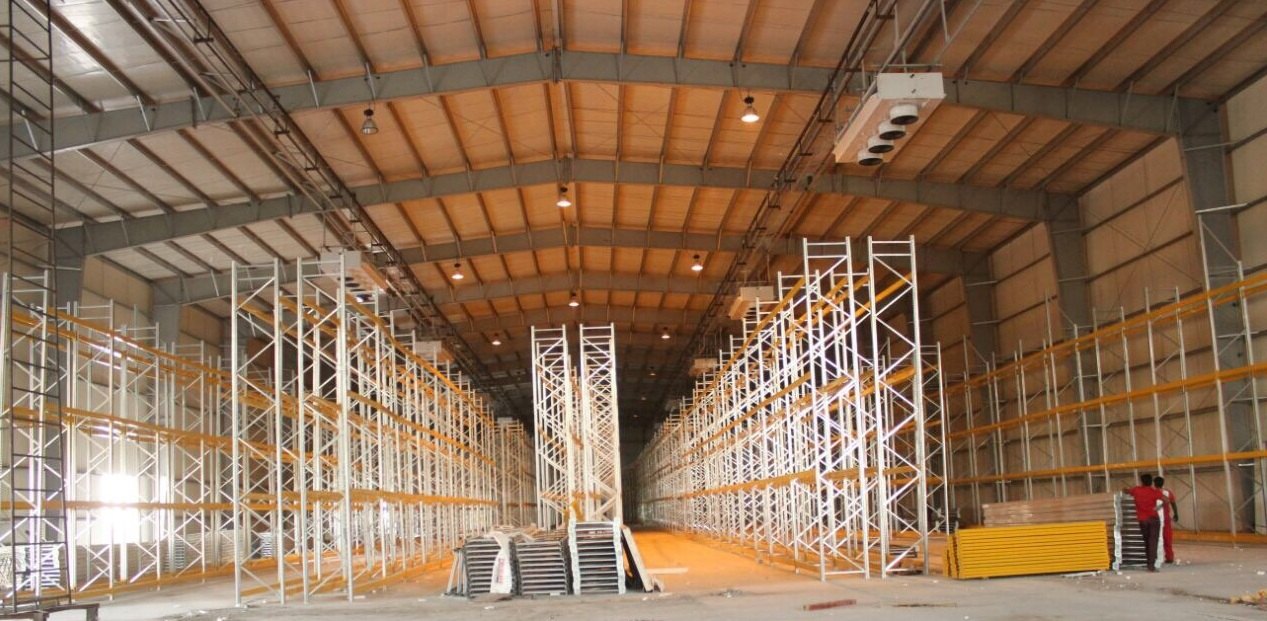
Inside a rack-supported chamber — the racking carries the insulated envelope, so there is no separate structural frame. From the Coldcare project library.
Rack-supported steel structures
The racking carries the insulated envelope, so there is no separate structural frame. Denser storage, faster erection, less steel overall. Best where produce is palletised or in jumbo bags and throughput is high. Coldcare has built this way since 2000.
Multi-tier mezzanine stores
Ground plus three, with steel mezzanine decks carrying the upper tiers. A quarter of the footprint for the same capacity — the right answer wherever land is expensive. Deck loads and material handling are designed together, not after.
PUF sandwich panel
100 mm core at 40 kg/m³ with pre-painted steel both faces is the standard for chilled storage; frozen chambers go thicker. We verify core density and skin thickness on site by cutting and weighing samples, because the difference between specified and supplied is paid for every month for twenty years.
Ammonia plants
More efficient and cheaper to run at scale; needs a trained operator and a proper machine room. Above about 5,000 MT it is almost always the right choice. Evaporative condensers, reciprocating compressors, full controls and commissioning in our scope.
Freon systems
Simpler, distributed, and the better answer for smaller or multi-chamber stores where a full machine room is not justified. We built one of the early rack-supported Freon cold stores in Andhra Pradesh.
Desiccant dehumidification
What makes low-humidity seed storage possible. Sized against the real infiltration load — door openings, anteroom, envelope leakage — not against a rule of thumb.
Racking, conveyor lifts and dock levellers
Adjustable pallet racking, chain conveyor lifts for bagged produce to upper tiers, box lifts, dock levellers and shelters. Handling decides usable capacity as much as the building does.
Monitoring and modernisation
IoT and RFID-enabled temperature and humidity monitoring, and the modernisation of existing stores — new plant, new controls, envelope repair — including stores we did not build.
Choosing between them
There is no universally correct technology, and anyone who recommends one before asking about your commodity, your land price and your electricity tariff is selling equipment rather than engineering.
| If this is true | Then usually |
|---|---|
| Land is expensive, capacity above 3,000 MT | Multi-tier, ground plus three |
| Land is cheap, produce is heavy and bagged | Single storey, conventional or rack-supported |
| Palletised produce, high throughput | Rack-supported construction |
| Capacity above 5,000 MT, operator available | Ammonia plant |
| Several small chambers, no machine room | Freon systems |
| Seed, or any commodity needing below 55% RH | Desiccant dehumidification, sealed envelope, anteroom |
Tell us what you want to store.
We come back with an indicative capacity, a cost range and the subsidy your project may qualify for. No obligation, no consultant's fee.
Tell us what you want to store.
We will come back with an indicative capacity, a cost range and what subsidy your project may qualify for. No obligation, and no consultant's fee.